
I thought I was well prepared for my first Hyrox race. I was wrong in a very specific way, and it is the same way most people are wrong.
I'd come off a marathon block a few months earlier. Running four or five times a week, lifting regularly, and I'd watched enough race footage to know the format cold. Eight kilometres of running, broken into one-kilometre legs, each followed by a functional workout station. Eight stations in total. I went in with a genuine aerobic base and what I thought was a clear picture of what I was walking into.
The thing that caught me off guard was my heart rate. Specifically, its refusal to come down between stations when I genuinely believed I was conditioned. Coming off a marathon, I assumed the running would be the easy part. It wasn't. The cumulative load of the stations meant I started every run leg already elevated, and I never fully recovered before the next one.
Running 42 kilometres at a steady pace and racing a Hyrox are two different sports that happen to share a movement. I learned that the hard way, which is generally how I learn things.
So if you've landed here wondering what Hyrox actually is, and quietly wondering whether you could do one, here's the honest version of both answers.
What is Hyrox?
Hyrox is a fitness race. Not an obstacle course, not a CrossFit competition, not a fun run with some weights thrown in. A race, with a clock, where every person on the start line completes the same course in the same order.
The format: run one kilometre, complete one functional workout station, run another kilometre, complete the next station. Eight rounds of that. Eight kilometres of running plus eight stations, and your time is your time.
Here's the part that matters more than it sounds: the station order never changes. Event to event, city to city, it's identical. Which means Hyrox is one of the only fitness competitions you can prepare for with complete precision. You know exactly what's coming, in exactly what order, at exactly what loads. Whether you've actually prepared for it is the whole question the race asks.
What are the eight Hyrox stations?
In order, every single time:
- SkiErg: 1,000m (solo) or 2 x 1,000m (doubles)
- Sled push: 50m
- Sled pull: 50m
- Burpee broad jumps: 80m
- Row: 1,000m
- Farmers carry: 200m
- Sandbag lunges: 100m
- Wall balls: 75 reps (solo) or 100 reps (doubles)
Loads vary by category (Open, Pro, Masters, Mixed Doubles, Same-Sex Doubles) but the movements don't. The elite athlete chasing a world qualifying time and the first-timer hoping to finish are doing the same race. There's something quite good about that, actually. Same course, same clock, your own fight.
What time should you be targeting?
Before you train for a Hyrox, it helps to have a goal time. A realistic one, built from your actual current fitness, not borrowed from someone's Instagram.
I've built a free Hyrox time calculator for exactly this. Put in your current running pace and where your strength sits, and it gives you a working target to train toward.
A target time isn't about pressure. It's about structure. Pacing a 90-minute Hyrox and pacing a 60-minute Hyrox are completely different races, and the run program, station strategy and training loads all flow from that number. Athletes who train without one tend to drift toward whatever feels comfortable, and comfortable is precisely what the back half of a Hyrox is not.
Why do runners struggle with Hyrox?
Most runners assume Hyrox will suit them, and I understand why, because I was one of them. The aerobic base does help. The kilometres count.
But eight kilometres of broken running, where every leg starts with your heart rate already high from a station, is a different stimulus to anything a distance program builds. Runners are trained to settle into a rhythm and hold it. Hyrox never lets you settle. The race keeps interrupting the one thing you're good at.
Then there's the strength side. Sled pushes, sandbag lunges, wall balls: most runners simply haven't built these, and the cost compounds. The leg fatigue from 100 metres of lunges doesn't politely wait until you've finished your next run kilometre. You carry it with you, and you find out exactly how much your running has been relying on fresh legs.
If you're a runner reading this and feeling slightly attacked, good. That awareness, applied eight weeks out from a race instead of during one, is worth a lot of minutes.
Why do gym-goers and lifters struggle with Hyrox?
From the strength side, the problem flips. The movements feel manageable in isolation. The SkiErg, the wall balls, the sled: done fresh, all fine. Done after a kilometre run, with seven more rounds in front of you, the maths changes completely.
The most consistent mistake I see from gym athletes is going out too hard on the first two or three run legs. It feels sustainable for about a third of the race. By station five it isn't, and the last three stations become an exercise in survival rather than racing. Watching a strong athlete walk the final run leg because they spent their race in the first fifteen minutes is common enough that we coach against it explicitly.
There's a technique gap too. A burpee broad jump for 80 metres has its own mechanics. Wall balls when your lungs are already working are a pacing skill, not just a strength one. These get trained deliberately or they get learned mid-race, and only one of those is enjoyable.
Training on the equipment you'll race on
One thing that genuinely moves race-day performance: training on the same equipment you'll meet on course.
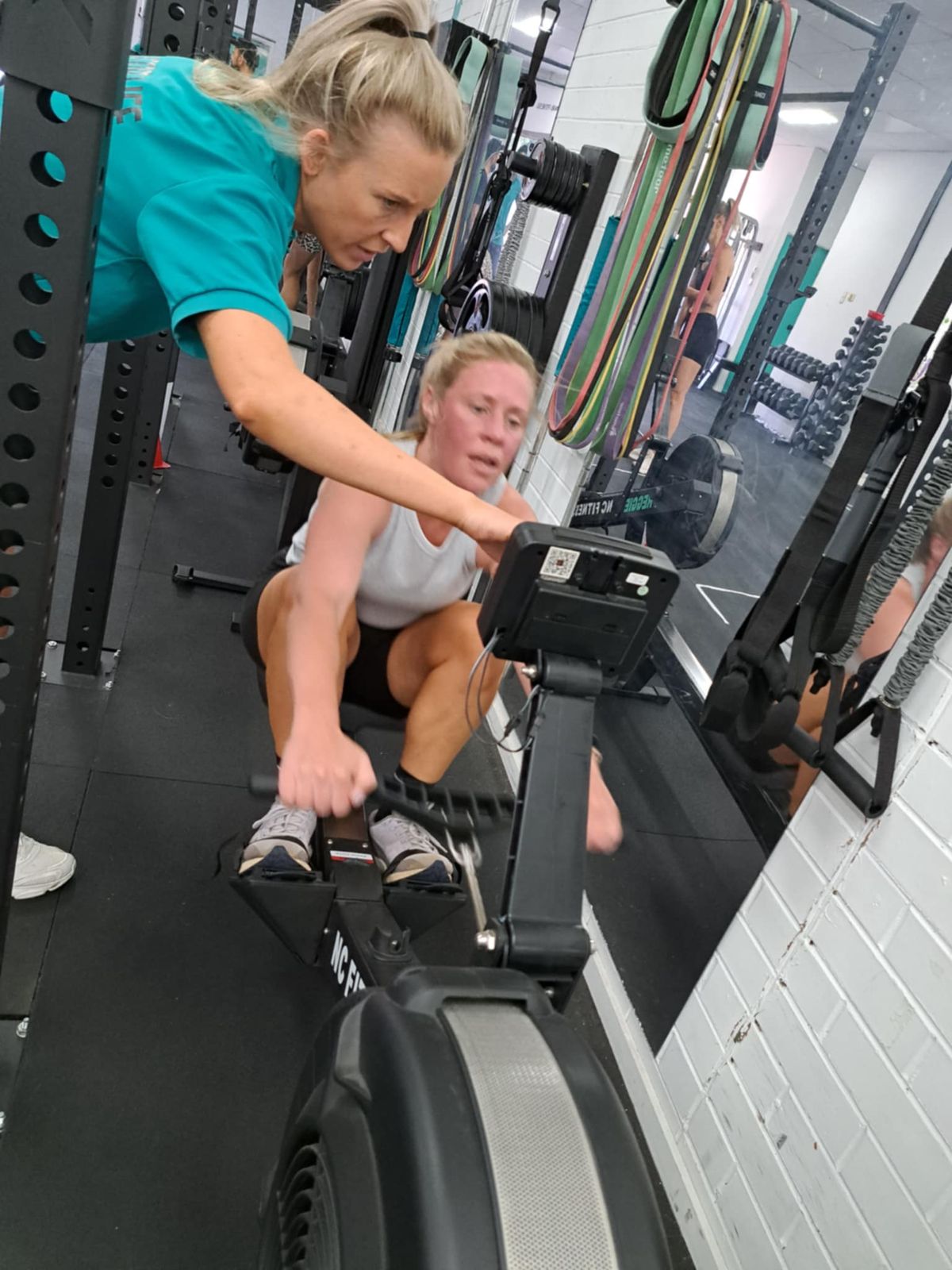
At Fit For Life we've got a dedicated sled track, ski-ergs, Concept 2 rowers, an assault bike and wall balls that mirror what you'll find at a Hyrox event. The point isn't that the gear is fancy. It's that your body learns specific loading patterns and efficiencies on that equipment, so race day holds no surprises. You've pushed that sled weight before. You know what 1,000 metres on that erg costs you. Confidence on a start line is mostly accumulated familiarity, even if that sounds a bit unromantic.
What Hyrox training at Fit For Life looks like
We've been building hybrid athletes out of Fit For Life since we opened in 2020, before most gyms in the Dandenongs were thinking about Hyrox at all. When the race format landed properly in Australia, we were already set up for it.
The program runs eight or ten weeks: two to three Hyrox-specific sessions a week, two run club sessions, and one or two strength sessions, adjusted to where you're starting from and what your race target is.
The coaching split is the real asset. Loz coaches the strength and station work: Cert III and IV in Fitness, a Metabolic Precision Nutrition qualification, a Hyrox Coaching certification, and she's raced. I coach the running as an Athletics Australia Level 1 and 2 accredited coach, with a competitive history through marathons, Ironman, and Hyrox at Brisbane (doubles) and Perth (solo). The heart-rate problem I described at the top of this article is now a thing I program for in other people, which is a more useful outcome than the race itself.
Every block includes a full race simulation before your event. You race the course in training before you race it for real. The difference that makes to how an athlete stands on a start line is hard to overstate.
Who is Hyrox for?
We coach four kinds of Hyrox athletes, and each one walks in carrying a different doubt.
You've never done one, and part of you isn't sure you can
That part of you is the most common athlete in the building, for what it's worth. The goal of a first Hyrox is to finish well, learn how to pace it, and discover which side of your fitness needs work. Nearly everyone crosses their first finish line and immediately wants to know how to go faster. We don't manufacture that. The race does it on its own.
You're a runner who needs strength
The running will hold you up; the stations will cost you. Your block prioritises Hyrox-specific strength, station technique, and the skill of transitioning from station back to run under fatigue.
You're strong but the running needs work
The opposite problem, equally fixable. We build the run program from where your running actually is, not where you'd like it to be, and that honesty early on saves a lot of frustration later.
You've raced and want to go faster, or qualify
This is where detail earns its keep: pacing per station, where your time is actually leaking, category strategy. One of our athletes, Katie, came through this program, finished second at Melbourne, then won Hyrox Brisbane outright. She races the World Championships in Stockholm in 2026. Results like that aren't talent alone. They're structure, applied for long enough.
"Hyrox is for everybody, whether you're a new mum, an elite athlete or a grandmother." We say that on our Hyrox page and we mean it. The honest caveat is that Hyrox asks you to develop the side of your fitness you've been avoiding. If you're willing to do that, you belong on a start line.
What to do next
If you're in the Dandenong Ranges or Melbourne's outer east and Hyrox has been sitting in the back of your mind, start with a number: use the Hyrox time calculator to get a realistic goal time, and let that shape the conversation from there.
Then, when you're ready to talk about what a training block would look like for you specifically, the program detail is on our Hyrox training page. Come have a look at the sled track while you're at it. It's opposite the Upper Ferntree Gully train station, which makes "I couldn't get there" a hard excuse to sustain.
Cheers,
Jonathan
Train for the floor.
Tell us your race date and we'll build the plan to get you there. Start with a free trial.
START YOUR HYROX JOURNEY
Tell us a little about your goals and we'll be in touch to get you started.